Kitchen Remodel Cost 2026: A Project Manager's Companion to the Calculator
Updated May 2026 · 16 min read
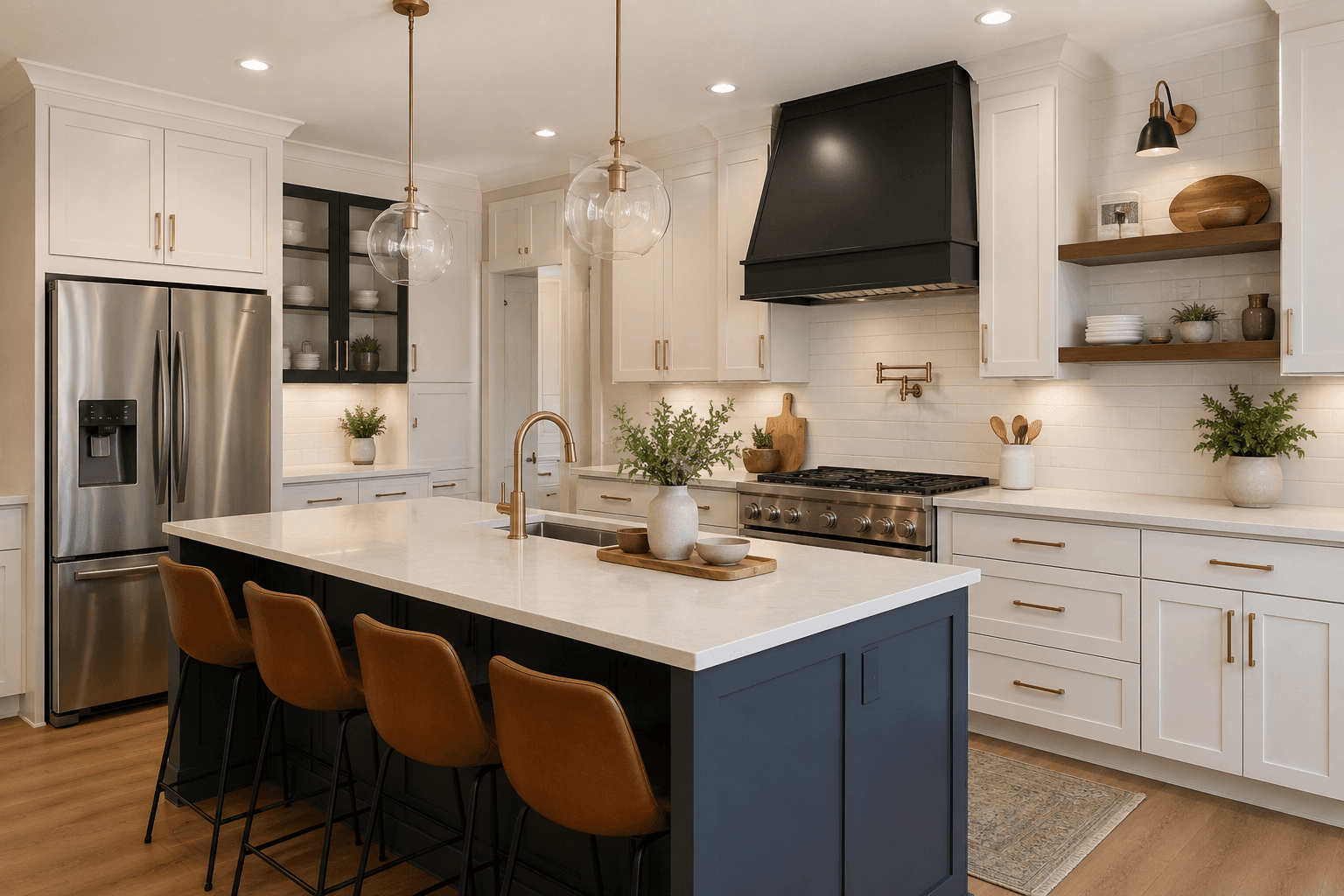
This isn't a “what does a kitchen cost?” article. This is the document we hand to clients after they run our kitchen remodel calculator — when the number on screen needs the technical context that turns it from a guess into a budget.
For 2026, the working ranges on real bids land at three scope tiers: $12,000–$28,000 for a cosmetic refresh, $32,000–$65,000 for a mid-range renovation, and $70,000–$180,000+for a gut + layout change (luxury custom can push past $240K in tier-1 metros). But the dollar range is the easy part. The hard part is the four cost drivers most online guides skip: code-compliance scope creep, fabrication surcharges on premium materials, the “footprint trap” on flooring, and the hidden labor premium on relocating wet/gas services. We'll cover all four.
If you haven't run a baseline yet, do that first. Run the calculator, then come back here for the technical sanity check on what your number actually has to cover.
Scope Tiers — What You're Actually Buying at Each Price Point
Three tiers cover 90% of residential kitchens. The difference between them isn't finishes — it's how much of the existing infrastructure you're leaving alone.
Tier 1: Cosmetic Refresh — $12,000–$28,000
Existing layout retained. No service relocations. No wall modifications. Mechanical, electrical, and plumbing (MEP) systems stay where they are.
- Cabinet refacing or paint-grade refinish (boxes retained)
- Hardware replacement and minor crown/trim updates
- Laminate or butcher block tops with existing sink cutout reused
- Direct-replace faucet, disposal, and supply stops
- Tile backsplash (15–25 sqft typical)
- Recessed LED retrofit on existing junction boxes
Active build is 2–4 weeks. This tier rarely triggers permit review unless your AHJ requires one for backsplash work near a range. ROI is high because cost basis is low.
Tier 2: Mid-Range Renovation — $32,000–$65,000
The most common scope we run. Same general footprint, but every major component is replaced and most MEP rough-in is touched at least once.
- Semi-custom or framed-overlay cabinetry, including pantry tower
- Quartz, mid-grade granite, or sintered stone tops with new sink cutout
- LVP or porcelain tile flooring within the existing kitchen footprint
- New 20A small-appliance circuits and dedicated dishwasher / disposal lines
- Range hood with proper CFM-to-make-up-air balance (more on this below)
- Pre-2026 panel? Plan on AFCI/GFCI breaker upgrades to pass inspection
Active build is 6–10 weeks. Permit lead time adds 4–8 weeks on top in most metros. This is where 70% of our 2026 bids are landing.
Tier 3: Gut + Layout Change — $70,000–$180,000+
Walls move. Sinks move. Gas lines move. Structural engineering enters the chat. Architect or design-build PM required.
- Frameless or fully custom cabinetry with integrated panel appliances
- Premium tops (porcelain slab, quartzite, marble) with mitered waterfall edges
- Plumbing relocation: sink, dishwasher, ice-maker, pot filler
- Gas line re-routing for range or cooktop relocation
- Load-bearing wall removal with stamped LVL or steel beam
- Sub-panel or 200A service upgrade to handle induction range, double oven, hood, and dedicated circuits
- Whole-house make-up air system if hood exceeds 400 CFM
Active build is 12–18 weeks. Architect + permit + structural stamps add another 8–14 weeks of pre-construction. Almost no project at this tier comes in at the bid number — budget a hard 12–18% contingency on top.
Line-Item Breakdown — and Why Each Number Fluctuates
Cost ranges only tell you half the story. The technical variables that move a number from the bottom of a range to the top are what you actually need to understand before you talk to bidders.
| Category | Budget | Mid-Range | Premium | % of Total |
|---|---|---|---|---|
| Cabinets & Hardware | $3,500–$9,000 | $9,000–$22,000 | $22,000–$48,000 | 25–35% |
| Why it fluctuates: Frameless vs. framed construction, soft-close hardware spec, and inset vs. overlay door style. Inset doors carry a 15–25% fabrication premium. | ||||
| Countertops | $1,800–$4,000 | $4,000–$9,500 | $9,500–$22,000 | 10–15% |
| Why it fluctuates: Edge profile and seam count. Mitered waterfall edges on porcelain slabs add 30–45% in fabrication labor due to CNC cracking risk. | ||||
| Flooring | $1,200–$3,200 | $3,200–$6,800 | $6,800–$13,500 | 7–12% |
| Why it fluctuates: Footprint changes force whole-house sand-and-finish on continuous hardwood — see Footprint Trap section below. Adds $4K+. | ||||
| Appliances | $2,400–$5,500 | $5,500–$13,500 | $13,500–$35,000 | 10–18% |
| Why it fluctuates: Induction ranges and 36"+ refrigerators may require dedicated 40A or 50A circuits and a panel slot — verify load calc before specifying. | ||||
| Plumbing | $700–$2,400 | $2,400–$6,000 | $6,000–$12,500 | 5–10% |
| Why it fluctuates: Slab-on-grade plumbing trenching for sink/island relocation runs $2,800–$5,500 just for the saw-cut, trench, and patch — separate from the rough-in. | ||||
| Electrical | $800–$2,400 | $2,400–$5,800 | $5,800–$11,000 | 5–10% |
| Why it fluctuates: Sub-panel requirements: induction range + double oven + dedicated circuits often exceed 100A panel headroom. Sub-panel + feeder = +$1,800–$3,400. | ||||
| Labor (GC + Trades) | $4,000–$9,500 | $9,500–$22,000 | $22,000–$45,000 | 22–28% |
| Why it fluctuates: Trade sequencing complexity. Layout changes mean plumber → electrician → drywall → tile → cabinet → countertop, with template lead times that extend the schedule 7–14 days. | ||||
| Backsplash | $500–$1,800 | $1,800–$4,200 | $4,200–$8,000 | 3–6% |
| Why it fluctuates: Sheet-good backsplashes (porcelain slab, glass) require a perfectly flat substrate; drywall float-out adds $300–$700 before tile sets. | ||||
| Permits, Design & Compliance | $400–$1,200 | $1,200–$3,800 | $3,800–$10,500 | 2–6% |
| Why it fluctuates: 2026 code triggers — see Hidden Code Compliance Tax section. AFCI/GFCI breaker mandates and make-up air for >400 CFM hoods alone can add $1,500+. | ||||
Reading the table:each row is an independent range — no single project hits every line at its maximum, and the % column reflects each line's share when it's the dominant cost driver (cabinets and labor compete for the biggest slice; they don't both hit max on the same job). For realistic project totals, anchor on the scope-tier ranges above ($12K–$28K cosmetic, $32K–$65K mid-range, $70K–$180K+ gut).
Cabinets — Where Spec Sheets Lie
Cabinetry is the largest single line item and the easiest one to misspecify. Stock RTA cabinets land at $80–$170 per linear foot installed. Semi-custom (Kraftmaid, Schrock, Diamond) runs $220–$540/LF. Fully custom frameless boxes with full-overlay or inset doors, dovetailed drawers, and Blum or Salice motion hardware push past $850/LF.
What actually moves the price within a tier: door style (inset doors are 15–25% more than full-overlay because of the precision tolerance), box construction(3/4" plywood vs. 5/8" particle), and finish(paint-grade vs. stain-grade vs. glazed adds tiers fast). Verify the door overlay spec on every quote — it's the line item where contractors quietly substitute.
Countertops — Read This Before You Pick a Material
Laminate at $18–$45/sqft installed. Quartz at $55–$110/sqft. Granite at $65–$130/sqft. Quartzite at $90–$180/sqft. Porcelain slab and marble at $110–$240+/sqft.
Beware of mitered edge surcharges on porcelain slabs. Fabrication labor for 12mm porcelain is currently running ~40% higher than 3cm quartz on equivalent work, because the CNC mitering process has a real cracking risk on thin porcelain. A waterfall island in 12mm porcelain that quotes at $4,200 in quartz will quote at $5,800–$6,400 in porcelain. Same square footage. Same visual outcome. Different fabrication time and risk premium.
Other fabrication variables that move the number: seam count (each additional seam is $80–$180 in fabrication time), edge profile (eased vs. beveled vs. mitered), cutout complexity (undermount vs. drop-in vs. integrated drainboard), and template lead time (most fabricators are running 8–14 days from template to install in 2026).
Flooring — and the Footprint Trap
Sheet vinyl at $2.50–$5.50/sqft, LVP at $4.50–$11/sqft, hardwood at $9–$17/sqft, large-format porcelain at $11–$22/sqft. See our flooring cost calculator for a deeper material breakdown.
The trap: changing the kitchen footprint — even just relocating the island or moving the pantry wall by 18 inches — almost always forces a flooring decision you didn't budget for. Full breakdown in the “Footprint Trap” section below.
Appliances — The Load-Calc Conversation
Basic package $2,400–$5,500. Mid-range stainless package $5,500–$13,500. Pro-grade (Sub-Zero, Wolf, Thermador, Miele) $14,000–$35,000+. Panel-ready integrated refrigeration alone runs $9,000–$18,000.
What most homeowners miss: the spec sheet on a high-end induction range or a 48" pro range tells you the amperage. A 36" induction range is a dedicated 40A circuit. A double wall oven is another dedicated 30–40A circuit. Together with a dishwasher, disposal, microwave drawer, and the two code-required 20A small-appliance circuits, you're burning through a 100A panel's headroom fast. Always confirm a load calc before signing the appliance order.
Plumbing & Electrical — The Layout-Move Penalty
If you keep the layout, MEP scope is $1,500–$4,200 combined. The second you move a sink off its existing drain, the math changes.
Slab-on-grade plumbing trenching for sink or island relocation runs $2,800–$5,500 just for the sawcut, trench excavation, and concrete patch — entirely separate from the $1,800–$3,500 plumbing rough-in itself. Above-grade homes with crawl-space access are cleaner: $1,200–$2,400 for the rough-in, no concrete work.
Electrical scope on a layout change almost always triggers a sub-panel installation if your main panel is already loaded. Budget $1,800–$3,400 for a 60–100A sub-panel with the feeder pulled from your main, plus another $400–$900 if the conductor has to cross a finished assembly. For pre-1978 homes, add $2,500–$5,000 for lead paint and asbestos mitigation if existing walls are opened.
Labor — Why the GC Charges What They Charge
GC overhead and supervision is 18–28% of hard cost in most metros. Trade specialists bill $85–$185/hour in 2026: plumbers at the high end, painters at the low end, tile setters and electricians in the middle.
Tier-1 metros (San Francisco, NYC, Boston, Seattle) carry a 35–55% labor premium over the national baseline. A mid-range kitchen that bids at $42K in Atlanta will bid at $58K–$66K in San Francisco for an identical scope. The materials cost the same. The labor is what moves.
The Hidden Code Compliance Tax (2026)
This is the single biggest discrepancy between online cost estimates and what you'll actually pay in 2026. Every Tier-1 metro and most IECC 2024-adopted jurisdictions are now enforcing kitchen-specific compliance requirements that didn't exist five years ago. None of them are optional. All of them cost real money.
1. AFCI / GFCI Breaker Mandate at the Panel
A kitchen permit in 2026 will, in nearly every NEC 2020+ jurisdiction, require AFCI (Arc-Fault Circuit Interrupter) protection on all 15A and 20A general-purpose kitchen circuits, plus GFCI (Ground-Fault Circuit Interrupter) protection on the two required 20A small-appliance circuits, the dishwasher branch, and the disposal branch. The kitchen SABCs need both— that's a dual-function (AFCI/GFCI) breaker, not one of each. Older panels often don't have either. Standard AFCI breakers run $45–$85 each; dual-function breakers run $50–$110 each. Hardware alone for a typical kitchen retrofit lands at $400–$900, plus 2–4 hours of electrician labor at $125–$185/hr.
2. Make-Up Air for High-CFM Range Hoods
Any range hood exceeding 400 CFM exhaust triggers a mandatory make-up air (MUA) system under IRC M1503.4 (M1503.6 in older code editions) — the trigger is CFM, not envelope tightness, though tight modern homes are where backdrafting actually shows up. Most pro-grade hoods over 36" exceed the 400 CFM threshold by default — a 48" Wolf or Vent-A-Hood pulls 600–1,200 CFM.
The MUA system is essentially a powered fresh-air intake that balances the negative pressure created by the hood, preventing backdrafting from gas appliances and water heaters. Equipment and install:
- Damper-only passive MUA: $600–$1,100 (works for hoods 400–600 CFM in mild climates only)
- Powered MUA with tempering (Broan, Fantech): $1,500–$2,800 equipment + $800–$1,400 install
- Heated/cooled MUA tied to existing HVAC: $2,400–$4,200 fully installed (required in cold-climate jurisdictions)
Skipping this is no longer an option in most metros. Inspectors are catching it at rough-in. We see homeowners on architect-spec'd kitchens get blindsided by this line item after countertops are already on order.
3. Energy Code Documentation (IECC 2024 / Title 24)
If your project crosses into “substantial alteration” territory (most layout changes do), you may trigger an energy compliance review covering insulation, fenestration U-values, and lighting power density. Stamped docs from a Title 24 or IECC-certified consultant run $400–$950.
4. Plumbing Code Updates
Most metros now require the dishwasher branch to terminate in an air gap (not a high-loop), and disposal connections must use a code-compliant flange and trap configuration. If your existing rough-in doesn't match, that's $250–$650 added at final inspection.
Total compliance tax on a typical 2026 mid-range remodel: $1,500–$4,500.None of it shows up in stock calculator estimates because it's code-specific to your jurisdiction. Always pad your budget here.
The Footprint Trap — Why “Just Moving the Island” Costs $4K+
One of the most common conversations we have with clients in 2026 sounds like this: “We just want to move the sink three feet and bump the island out a little.” We then walk them through what that actually costs once you account for the floor.
Most homes built in the last 25 years have continuous hardwood or LVP running from the kitchen into the adjacent dining or living space — there's no transition strip at the kitchen doorway. The flooring is one continuous plane.
The moment you change the kitchen footprint — relocate the island, pull the pantry wall, expand the perimeter cabinets — you create a floor patch problem:
- The new cabinet footprint exposes raw subfloor where cabinets used to be, and covers existing finished floor where new cabinets land.
- Patching with new boards almost never matches the existing finish — even “same species, same grade” new wood is a different age and oxidation level than 8-year-old flooring.
- The only clean fix on continuous hardwood is a whole-house sand-and-finish: pull baseboards, feather in new boards at the patch, sand the entire connected floor plane to bare wood, and re-finish with 2–3 coats of poly. This gets you a uniform color and seamless transition.
2026 pricing for whole-house sand-and-finish:
- Site-finished oak/maple:$4.50–$7.50/sqft. On a 1,200 sqft connected floor plane, that's $5,400–$9,000.
- Engineered hardwood (refinish-capable): $5.00–$8.50/sqft. Some engineered floors only have 1–2 refinish cycles in their wear layer — verify before sanding.
- LVP / sheet vinyl:Can't be refinished. You either accept a visible patch, run a transition strip at the kitchen doorway (looks intentional if planned), or replace the entire continuous run.
The headline: budget $4,000–$9,000 in unbudgeted flooring costs on any kitchen remodel that changes the footprint, even slightly. The cleanest way to avoid this is to keep the cabinet footprint identical and just upgrade within the existing perimeter — that decision alone has saved our clients high four figures more times than we can count.
Kitchen Remodel Cost by Location
Location is the single largest variable on labor cost. The same scope, same materials, same contractor experience level can swing $20,000+ depending on metro. Here are the multipliers we calibrate against in 2026:
| Region | Cost Multiplier | Mid-Range Remodel |
|---|---|---|
| San Francisco / NYC | 1.35–1.50× | $50,000–$75,000 |
| Boston / Seattle / LA | 1.15–1.35× | $40,000–$60,000 |
| Denver / Chicago / Miami | 1.00–1.15× | $35,000–$50,000 |
| Dallas / Phoenix / Atlanta | 0.90–1.05× | $30,000–$45,000 |
| Midwest / Southeast Rural | 0.75–0.90× | $22,000–$38,000 |
Our kitchen remodel calculator uses pricing data from 400+ locations across the US to give you a localized estimate based on your ZIP code.
5 Ways to Actually Reduce Cost (Not the Tired Ones)
1. Lock the Footprint
The single highest-leverage decision you can make. Keep every cabinet box, every wet location, and every gas appliance on its existing rough-in. You eliminate the slab trenching, the sub-panel, the make-up air retrofit, and the whole-house flooring sand-and-finish. We routinely see this single decision save $8,000–$18,000 versus an “identical” layout change.
2. Reface Instead of Replace (When the Boxes Hold Up)
If your existing cabinet boxes are 3/4" plywood with intact face frames and no water damage, refacing — new doors, drawer fronts, hardware, and end panels — runs 40–55% less than full replacement. Verify the box construction first; refacing particle-board boxes is throwing money away.
3. Spec Quartz Over Porcelain Slab on Waterfall Islands
Quartz mitering is mature fabrication tech in 2026. Porcelain mitering is still high-risk. If your design includes a waterfall island and your timeline is tight, quartz at $55–$95/sqft delivers the same visual outcome as porcelain at $130–$200/sqft, with 40% less fabrication labor and almost no CNC re-cut risk.
4. Run the Calculator Before You Touch Pinterest
Most remodel overruns start with finish-level dreaming before anyone ran a baseline. Use our calculator to set the upper bound of what your scope can realistically absorb, then design within that envelope. Reverse-engineering a budget around an inspiration board never works.
5. Bid Apples to Apples — and Read the Exclusions
Three to five bids minimum. But the comparison happens in the exclusions section, not the price. The cheap bid almost always excludes: AFCI/GFCI breaker upgrades, make-up air, sub-panel installation if needed, slab trenching for sink moves, and flooring patch/refinish. Force every bidder to address those five items in writing before you compare totals.
Related Cost Calculators
Planning more than just a kitchen? Check out our other calculators:
- Bathroom Remodel Cost Calculator
- Flooring Cost Calculator
- Interior & Exterior Painting Cost Estimator
- Room Addition Cost Calculator
Kitchen Remodel Cost FAQ
What's the realistic 2026 budget range for a kitchen remodel?
On bids we're scoping right now: cosmetic refresh lands at $12,000–$28,000, mid-range renovation at $32,000–$65,000, and gut-with-layout-change at $70,000–$180,000+. Tier-1 metros (San Francisco, NYC, Boston, Seattle) push another 35–55% on top of those numbers because of labor. Add a hard 12–18% contingency on any layout change — that's the budget reality, not the marketing range.
Why does my contractor's quote include $1,500 for 'make-up air' I didn't ask for?
Because IRC M1503.4 (M1503.6 in older editions) requires it on any range hood exceeding 400 CFM, and most pro-grade hoods over 36 inches blow past that threshold by default. The make-up air system balances the negative pressure your hood creates, preventing backdrafting from gas appliances and water heaters. Skipping it means your AHJ red-tags the rough-in and you pay for it twice. Powered MUA systems run $1,500–$2,800 in equipment plus $800–$1,400 install. It's a real line item, not a contractor markup.
What's the most expensive line item — and where do bids vary the most?
Cabinetry is the largest single cost (25–35% of budget), but it's not where bids vary the most. The variance lives in MEP scope. A bid that includes proper sub-panel installation, slab trenching for sink relocation, AFCI/GFCI breakers, and a code-compliant make-up air system can be $5,000–$12,000 higher than a bid that quietly excludes those items. The total cabinet cost between two bidders is usually within 15%. The MEP scope can vary by 100%+.
Why is porcelain countertop fabrication so much more expensive than quartz?
Two reasons. First, 12mm porcelain slabs require specialized CNC tooling that not every fab shop has — fewer shops bid the work, and the ones that do command a premium. Second, the cracking risk on mitered porcelain edges is real; fabricators price in a 30–45% labor premium over equivalent 3cm quartz miters to absorb the re-cut risk. Visually, the finished outcome looks similar. Cost-wise, you're paying for fabrication risk transfer.
How long does a kitchen remodel actually take in 2026?
Permit lead time alone is 4–8 weeks in most metros before active work even starts. Cosmetic refresh is then 2–4 weeks of build, mid-range is 6–10 weeks, and gut + layout change is 12–18 weeks. The longest pole on every project we run is the cabinet lead time (8–14 weeks for semi-custom, 12–20 weeks for fully custom) and the countertop template-to-install window (8–14 days from template). Plan the order schedule first, the construction schedule second.
Can I really do a kitchen for under $20,000?
Yes, if you respect three constraints. One: don't touch the layout — every wet, gas, and electrical connection stays exactly where it is. Two: reface the cabinet boxes instead of replacing them (assuming they're plywood, not particle). Three: laminate or butcher-block tops, basic backsplash, retrofit LEDs into existing junction boxes, direct-replace faucet. That gets you to $14K–$22K. The minute you move a sink or relocate a range, you've crossed into mid-range scope — there's no honest way to do that for under $30K in 2026.
I keep getting wildly different quotes — what should I actually compare?
Force every bidder to address these five exclusions in writing before you compare totals: (1) AFCI/GFCI breaker upgrades on the panel, (2) make-up air system if any new hood exceeds 400 CFM, (3) sub-panel installation if your existing main panel is loaded, (4) slab trenching costs if a sink or island is moving, (5) flooring patch or whole-floor sand-and-finish if the cabinet footprint changes. Once those are written into every bid, the price differences become explainable. Without them, you're comparing apples to oranges and the cheap bid is just a change-order trap.
Get an Instant Kitchen Remodel Estimate
Describe your project or upload a photo — our AI generates a detailed, line-item cost breakdown in under 30 seconds. Free, no sign-up required.