How to Bid a 10x12 Deck: 2026 Contractor Pricing Breakdown
Published May 2026 · 13 min read
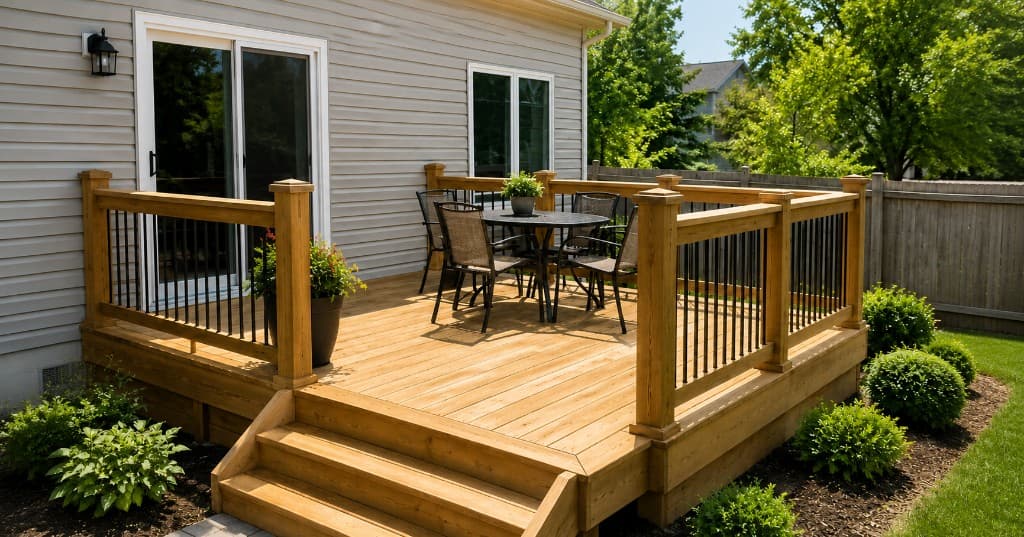
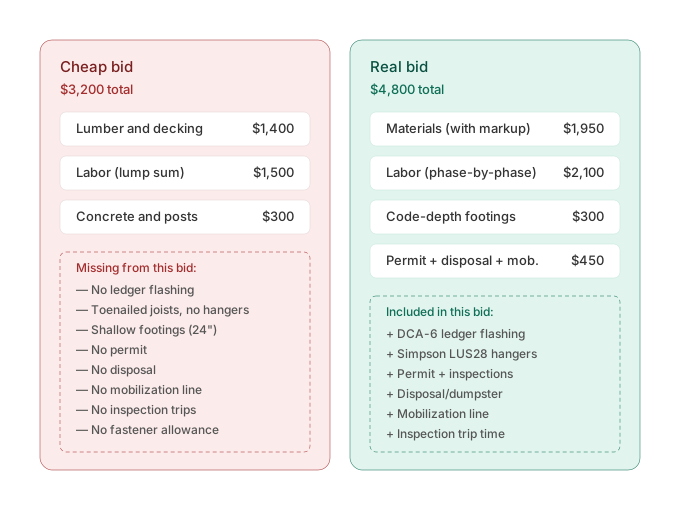
Two contractors walk a job site for the same 10x12 pressure-treated deck. Same materials. Same site. Same homeowner. Their bids come back $1,600 apart.
The cheap one isn't undercutting on labor — they're missing line items. The expensive one isn't padding — they're including the work that actually has to happen. Whichever side of that gap you're on, you're either bleeding margin or losing jobs you should have won.
This breakdown is the bid sheet behind a real 10x12 pressure-treated deck quote in 2026. Not a homeowner's “how much will it cost me” article — those exist on every site that ranks on Google. This is what goes into your spreadsheet before the homeowner sees a number.
10x12 deck bid: cheap vs. real
Same job, two contractors. The gap is in the line items.
The 2026 Market Reality
Before the line items, the macro picture every deck contractor is bidding into right now.
Material side
- Pressure-treated lumber leveled off in late 2025 after three years of wild swings. Expect 2x8x12 PT joists in the $20–$45 range at retail, varying by region, grade, and supplier relationship. Pro accounts at Home Depot or Lowe's typically run 5–12% below retail; local lumber yards can be cheaper or more expensive depending on volume.
- Composite (Trex, TimberTech, Fiberon) has been climbing 2–5% year-over-year for several seasons.
- Cedar and redwood prices have been climbing on supply constraints — verify current pricing with your supplier before bidding.
- Simpson Strong-Tie hardware pricing is steady. On a 10x12 deck, figure roughly $150–$250 in hangers, post bases, and hurricane ties using current Simpson pricing.
Labor side
- Skilled deck carpenter labor remains tight in most metros. Carpenter rates vary widely by region — coastal urban markets run $50–$80/hour, rural markets $30–$50/hour. Helper rates typically 60–70% of carpenter rate.
- Permit timelines have stretched in many jurisdictions. Plan for 5–15 business days for review on a typical residential deck permit. Some metro counties stretch to 20+ days.
That's the context every bid lives inside. Now the line items.
Material Costs at Trade Pricing — Not Retail
The Decks.com calculator says “$3–$6/sqft for pressure-treated decking material.” That's a homeowner number. It's also wrong for your bid.
Here's what a real material list looks like for a 10x12 ground-level pressure-treated deck (no railing on three sides, single 4-step staircase). Use this as a framework — verify current pricing with your local supplier:
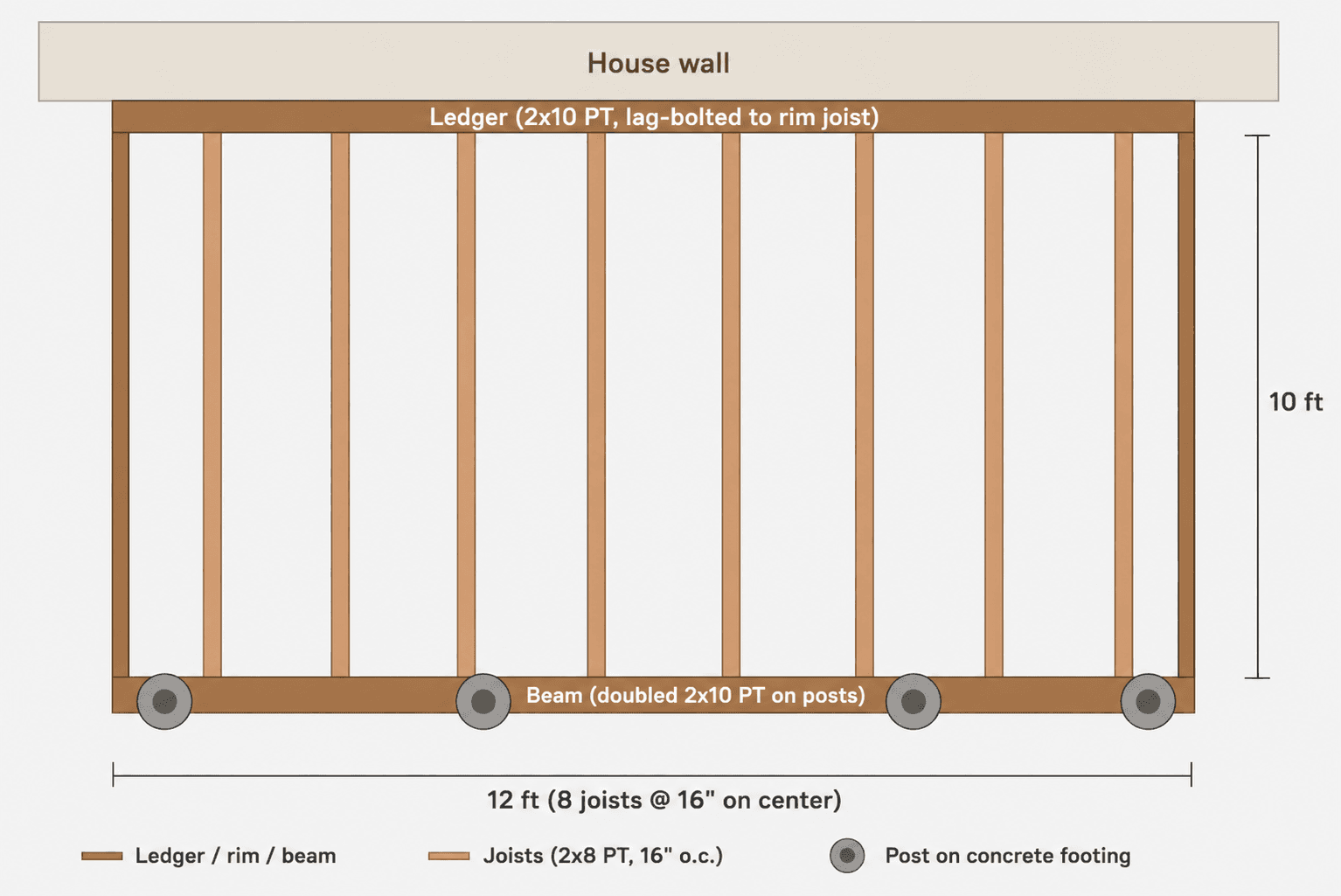
10x12 deck framing: top view
What you're paying for. Each component has a code-driven spec behind it.
Framing
- 2x10x12 PT ledger: 1 piece (lag-bolted to house rim joist)
- 2x10x12 PT beam (doubled, set on posts): 2 pieces
- 2x8x10 PT joists at 16" o.c.: 10 pieces (includes the two outside joists)
- 4x4x8 PT posts: 4 pieces (code-minimum for short, low-tributary posts per IRC R507.4 and DCA 6-23 Table 6) — many pros default to 6x6x8 PT instead for better notch capacity at the beam-to-post connection, more rot-resistant cross-section, and future load flexibility (railing newels, pergola, hot tub).
- 2x4x8 PT blocking and bracing: 6 pieces
Decking
- 5/4x6x12 PT decking: 22 pieces
Stairs
- 2x12x10 PT stringers: 3 pieces
- 5/4x6x10 PT treads: 8 pieces
- 2x4x8 PT risers: 2 pieces
Hardware (Simpson Strong-Tie or equivalent)
- LUS28 joist hangers: ~16 pieces (ledger-to-joist and rim-to-joist)
- H1 hurricane ties: ~8 pieces
- PB44 post bases: 4 pieces (PB66 if you upsize to 6x6 posts)
- 5/4 deck screws (5-lb box): 1 box
- 3-1/2" structural screws (5-lb box): 1 box
Concrete and footings
- 60-lb concrete bags: ~8 bags
- 8" Sonotube forms: 4 pieces
- Rebar
Misc
- Construction adhesive, caulk, flashing tape, ledger bolts, lag screws
Realistic material total at retail pricing: typically $1,600–$2,100 for a standard 10x12 PT deck depending on region and supplier. Trade pricing through a pro account at Home Depot, Lowe's, or a local lumber yard typically lands 10–15% below that — call it $1,400–$1,800 at trade. Add a 10–12% waste factor on lumber on top.
The Decks.com chart told the homeowner “$648 in pressure-treated decking material” for a 10x12. That's accurate — for the deck boards alone. It excludes framing, hardware, concrete, fasteners, and waste. Real material cost is roughly 2–3x what the consumer-facing tools quote.
This is the first place margin disappears on cheap bids: contractors pricing the deck boards and forgetting everything underneath.
Labor Calculation: Hours Per Phase, Not Lump Sum
The biggest mistake on cheap deck bids is pricing labor as a lump sum or per-square-foot rate. Real labor pricing is hours per phase × crew rate, summed.
For a standard 10x12 ground-level pressure-treated deck with a single 4-step staircase, here's a realistic phase-by-phase labor framework for a 2-person crew. Adjust based on your crew's experience and site conditions.
Phase 1: Layout and excavation
- Mark deck footprint, locate footings
- Hand-dig or auger 4 footing holes to required depth
- Frost-line depth varies by region per IRC R403.1.4 — verify with local AHJ. Northern climates with 42"+ frost lines will take longer than warm climates with shallow footing requirements.
- Eyeball soil at the bottom of the hole — if you're into soft clay or silt, upsize to 10" or 12" Sonotubes per IRC Table R401.4.1 instead of the default 8".
Phase 2: Footings and posts
- Set Sonotube forms, mix and pour concrete
- Set Simpson PB44 post bases in wet concrete
- Plumb and brace posts
- Critical: cure time before next phase (24–48 hours minimum)
Phase 3: Ledger and beam install
- Locate ledger height, cut siding and house wrap back
- Self-adhering flashing tape over sheathing, lapped under the upper WRB (per DCA-6 / IRC R703.4)
- Lag-bolt ledger to rim joist (not just the siding) per IRC R507.9
- Metal Z-flashing over top of ledger, tucked up behind the upper WRB
- Set beams on posts, level and secure
Phase 4: Joist install
- Hang joists 16" on center using LUS28 hangers per IRC R507.5
- Crown joists, cut to length, install rim board
- Install H1 hurricane ties at every joist-to-beam connection per IRC R507.5.1
Phase 5: Decking install
- Square first board off ledger
- Pre-drill (PT splits without it), screw down with hidden fasteners or face screws
- Maintain 1/8" gap between boards (PT shrinks more than composite)
- Cut around posts, end-trim final board
Phase 6: Stairs
- Calculate rise/run, cut stringers
- Notch stringers for treads
- Install treads and risers
- Verify code-compliant rise/tread per IRC R507.13.3
Phase 7: Cleanup and final
- Remove debris, return scrap lumber
- Touch up cuts with end-grain sealer
- Walk-through with homeowner
Realistic total labor for a standard 10x12: typically 28–42 crew-hours for a 2-person crew, depending on site conditions, crew experience, and frost-line depth. Add 15–20% for non-billable time (loading/unloading, drive time, supply runs).
This is where the cheap bid breaks. A flat “$1,200 for labor” line, with no phase math behind it, almost always means one of three things on a real job: the contractor will eat the difference, cut corners on the phases the homeowner can't see (footings, ledger flashing, joist hanger spec), or recover the margin through change orders later.
The Hidden Cost Recovery Line Items
These are the line items that turn a break-even job into a profitable one. Cheap bidders silently absorb them until they're either eating margin or padding labor (badly) to compensate. Whether you call them out on the bid or bury them in markup is a style choice — leaving them out is a math error.
1. Mobilization
The work of getting your crew, tools, and material to the job site isn't free. Loading the truck, drive time, supply runs mid-job, and the inevitable return trip for the tool someone left behind add up to a half-day of effective billable time per crew across a typical multi-day deck project. Bury it in general conditions or break it out as a flat fee — typical range $200–$600 — but charge for it.
2. Demo and disposal
Replacing an existing deck? Add 4–8 crew-hours and a dumpster. Even no-demo new builds generate 1–2 cubic yards of cut-offs, packaging, and concrete spillage that has to go somewhere. A 10-yard dumpster runs $300–$700 in most markets, more in tier-1 metros. Pickup-truck dump runs save the rental fee but consume crew time at billable rates.
3. Permit fees and your time inside the permit office
The permit fee itself is $75–$400 in most jurisdictions. The hidden cost is your time: 1–2 hours filing, 2–4 hours waiting on inspection appointments (which never happen at the time they say they will), and revision cycles when the AHJ wants a load calc, a survey, or a setback verification you didn't include the first time. Budget $200–$500+ in your time on top of the fee.
4. Fastener and tooling allowance
Most cheap bids price one box of structural screws and one box of joist hanger nails. Real-world consumption on a 10x12 with ledger work and a stair stringer is 1.5–2 boxes of each. Add saw blades, drill bits, and the sandpaper you'll burn through — figure $25–$75 per job in disposable tooling on top of fasteners.
5. Inspection-driven extra trips
Most jurisdictions require a footings inspection before pour, then a framing inspection beforedecking. That's two extra mobilization cycles your single-day-per-phase plan didn't account for. If the inspector reschedules, that's a third.
A “hidden cost recovery” line should appear on every deck bid. The contractors who skip it lose money on jobs they thought were profitable.
Markup Methodology — Material vs. Labor
Industry-standard markup is different on materials versus labor versus hardware versus subs. Bidding flat 20% across the board leaves money on materials and overprices labor — both of which erode margin in different ways.
Working ranges (verify with your accountant for your market)
- Material: 25–50% markup on trade cost.A pro account at Home Depot or Lowe's typically gets you 5–15% off retail. You then mark that trade cost back up to 25–50% above what you paid. Lumber and concrete have lower markup ceilings (commodity, easy to price-check). Engineered wood, premium decking, and specialty fasteners can carry the full 50%.
- Labor: 0–15% markup on top of fully-loaded burdened rate. Your labor sell rate already includes overhead in the burdened number — adding more on top makes you uncompetitive. Use the small markup for risk premium on jobs with unknowns.
- Subcontractor: 10–20% markup. Concrete pour, electrical for low-voltage deck lighting, anything you sub out.
- Hardware: 30–50% markup.Joist hangers, post bases, hurricane ties, lag bolts. Small items, high margin, homeowners don't price-check them line-by-line.
Worked example for a 10x12 PT deck
- Material at trade cost: ~$1,400–$1,800 (varies by region)
- Material billed at 35% markup: ~$1,890–$2,430
- Labor fully loaded at 28–42 crew-hours × blended rate (varies by region)
- Labor billed at 10% markup
- Hardware billed at 40% markup
- Hidden cost recovery: $400–$600
- Final bid range: typically $4,800–$6,500 in most U.S. markets
The competitor at $3,200 is doing one of three things: cutting corners (skipping flashing, undersizing footings, missing hurricane ties), absorbing the gap out of pocket, or recovering it through change orders later. None of those is a long-term business model. Your bids don't have to be the cheapest — they have to be the right one for the work that actually has to happen.
Permit and Code Reality
Code compliance is non-optional and non-negotiable, and the inspector catches the cheap bid every time. The details that fail residential decks most often:
- Frost-line depth — IRC R403.1.4. Footings have to extend below the local frost line. Verify with your AHJ before quoting; this varies dramatically by region and has zero national default.
- Soil bearing capacity — IRC R401.4 and Table R401.4.1. Frost depth tells you how deep; soil bearing tells you how wide. An 8" Sonotube has roughly 0.35 sqft of bearing area, which works in 3,000+ psf sandy gravel but is undersized in ~1,500 psf soft clay or silt. On a 10x12 each footing carries roughly 800–1,100 lb at code live load — in soft soils that means 10" or 12" tubes, not 8". Eyeball the spoils when you dig the test hole and upsize if you're into clay. If you're unsure, your AHJ may require a soils report.
- Ledger attachment and flashing — IRC R507.9, R703.4, and DCA-6 Figure 17. The most-skipped detail in residential deck construction, and inspectors know it. Lag-bolt the ledger to the rim joist (not the siding), then build the flashing in the correct shingling sequence so water sheds outward, not into the wall:
- Cut the house wrap (WRB) horizontally above the ledger location.
- Self-adhering flashing tape (Vycor Deck Protector or equiv.) over the sheathing, lapped under the upper WRB.
- Install ledger.
- Metal Z-flashing (deck-to-wall flashing) over the top of the ledger, vertical leg tucking up behind the upper WRB.
- Siding back over, leaving a 1/4" gap above the flashing for drainage.
- Post sizing — IRC R507.4 and DCA 6-23 Table 6. 4x4 PT is code-permitted up to 8' post height with limited tributary area (~35–40 sqft per post), which technically covers a low 10x12 with 4 posts. But check actual tributary load before defaulting to 4x4: tall posts (over ~4' exposed), high tributary, or any future load expectation (pergola, roof, hot tub) push you to 6x6. Many jurisdictions and most pro shops have made 6x6 the default regardless.
- Joist hangers and the right fastener — IRC R507.5 and R507.6.1. Use Simpson LUS-series or equivalent at every joist-to-rim and joist-to-beam connection. Joist hanger nails specifically are required — deck screws are explicitly prohibited per R507.6.1.
- Hurricane ties / joist-to-beam restraint — IRC R507.5.1. Simpson H1 or equivalent at every joist-to-beam connection. DCA-6 Figure 6 details acceptable alternatives.
- Lateral load to house — IRC R507.9.2. Two 1,500-lb tension ties (or equivalent engineered solution) connecting the deck framing back to the house framing. Introduced in the 2009 IRC after a series of deck collapses. Inspectors check it.
- Guards and stairs — IRC R312 and R507.13.3. 36" minimum guard height on residential decks above 30" from grade. 4" sphere rule for baluster spacing. Stair rise/tread/nosing per your code edition.
A failed inspection means a 2–3 day delay, $200–$500 in remediation labor, and a homeowner who doesn't trust you anymore. Build the code into the bid.
Bottom Line
Bidding a deck is a phase-by-phase calculation, not a per-square-foot estimate. The contractors who do this well protect margin and win repeat work; the ones who don't burn out within 2–3 seasons. Use your bid sheet to price the work that has to happen — the footings under code, the flashing per DCA-6, the hardware per Simpson spec — not just the work the homeowner sees in the photos.
If you want to validate your bid math against current regional pricing, run our deck cost estimator for 400+ U.S. ZIP codes. Bidding a room addition next? See our room addition cost breakdown for the same phase-by-phase methodology applied to a bigger envelope.
Related Cost Calculators
- Deck Cost Estimator
- Room Addition Cost Calculator
- Interior & Exterior Painting Cost Estimator
- Siding Cost Calculator
Deck Bidding FAQ
How long does a 10x12 deck actually take to build?
Four to six working days for a 2-person crew is typical, including 24–48 hours of cure time on the footings before you can frame off them. Faster timelines (1–2 days) are either skipping cure time on concrete, building over existing footings, or both — and either way you're now signing your name to someone else's structural work.
What's the markup standard on Trex/composite vs. pressure-treated?
Pressure-treated has lower margin opportunity because it's a commodity material that homeowners can price-check at any big-box store. Bid PT at 25–30% material markup. Composite (Trex, TimberTech, Fiberon) has better margin — homeowners don't comparison-shop board-by-board, and manufacturer pricing is more stable. Bid composite at 35–50% material markup.
Do I need to bond and insure as a contractor for residential decks?
Most jurisdictions require general liability ($1M minimum is the floor) and workers' comp if you have employees. Some states require contractor licensing for any structural work — and a deck with a ledger attachment to the house is structural. Check your state's contractor licensing board before bidding outside your home market. One uninsured incident on a structural deck is enough to wipe out years of margin, so this is not a corner to cut.
What's a fair contingency line for unknown conditions?
10% of the total bid for known-clean sites — open backyard, level grade, no demo, clear access. 15–20% for sites with unknowns: building over existing concrete, near a grade transition, suspect drainage, or possible buried utilities. The contingency isn't padding; it's the line you tap when you find something the site walk didn't reveal. If you don't use it, you can return it at close-out — that's a great way to build trust on the next job.
How do I handle change orders?
Written, signed, with the cost increase clearly stated, before any change-related work begins. Homeowner says "can we add a step?" — you write the change order, get the signature, then add the step. Never verbal, never "we'll figure it out at the end." Verbal change orders are the single biggest source of receivables disputes on residential remodel work.
What's the warranty standard on a residential deck?
One- to two-year workmanship warranty is the industry standard on residential decks. Material warranties (Trex 25-year limited, TimberTech 30-year limited, Simpson Strong-Tie's hardware coverage) are pass-through from the manufacturer — you're just registering the homeowner. Make sure your warranty document is explicit about what's workmanship versus material, because homeowners don't make that distinction on their own.
Should I bid retail material cost or trade cost in front of homeowners?
Don't itemize materials at all on the homeowner-facing bid. Bid total project cost. If they push for a breakdown, give percentages (roughly 50% material, 40% labor, 10% other) — not line-item costs. The moment you show retail line items, you've invited the homeowner to price-check every screw at Home Depot, and you'll spend the rest of the negotiation defending margin instead of selling the work.
Validate Your Deck Bid Math
Run a deck-specific cost estimate against regional pricing for 400+ U.S. ZIP codes — material, labor, and code-compliance scope, in seconds. Free, no sign-up required.